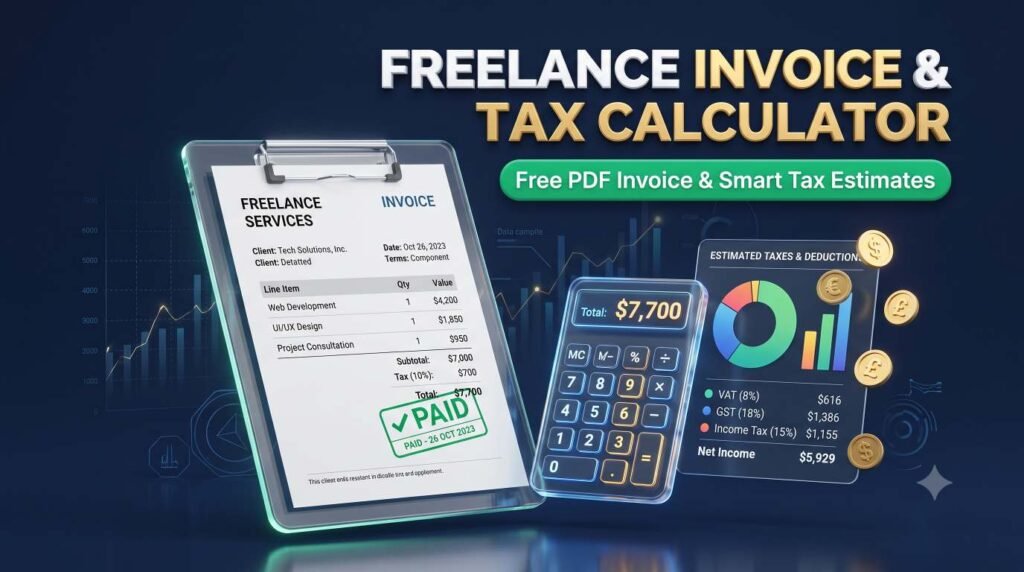
Freelancer Invoice Tax Calculator: Estimate Net Pay Fast
Calculating billable client totals without factoring in self-employment taxes, VAT, or withholding rates often leads to costly surprises at tax time. Using an interactive freelancer invoice tax calculator ensures that independent contractors, digital nomads, and agency freelancers accurately project take-home profits before dispatching official invoices.
How Self-Employment Tax Withholding Works for Freelancers
Unlike traditional W-2 employees whose employers automatically withhold income taxes and social security contributions, independent 1099 contractors are responsible for both employee and employer tax obligations.
In the United States, this is governed by the IRS Self-Employment Tax (FICA) Guidelines, which totals 15.3% (12.4% for Social Security and 2.9% for Medicare). Failing to set aside 25% to 30% of every incoming client invoice can leave freelancers facing severe penalties when filing quarterly estimated taxes (Form 1040-ES).
| Tax Category | Standard Rate | Who Must Pay |
|---|---|---|
| US Self-Employment (FICA) | 15.3% on net earnings | US 1099 Sole Proprietors & LLCs |
| Federal / State Income Tax | 10% to 37% (Bracket dependent) | All annual earnings above standard deduction |
| VAT / GST (UK & International) | 5% to 20% on gross billing | VAT-registered international freelancers |
Why You Need a Freelancer Invoice Tax Calculator
Manually calculating hourly rates, line-item expenses, sales tax, and withholding percentages in spreadsheets is prone to arithmetic blunders.
Our dedicated Free Freelancer Invoice Tax Calculator automates this entire equation. Simply enter your project fee, select your tax percentage, and instantly visualize your gross invoice amount, tax withholding reserves, and true net profit.
Tax Formulas: US 15.3% FICA vs UK HMRC vs European VAT
Depending on your client's geographical location:
- Domestic US Invoices: You do not collect sales tax on freelance services in most states, but you must reserve 25% of net profits for IRS Schedule C obligations.
- Cross-Border Invoices: US freelancers billing overseas clients are generally exempt from local foreign VAT under reverse-charge rules.
- European Invoicing: Freelancers registered for VAT in the UK or EU must add standard VAT rates (such as 20% in the UK) to the invoice line subtotal.
Using a reliable freelancer invoice tax calculator keeps your bookkeeping synchronized across multi-currency client contracts.
Professional Invoicing Workflow & Digital Signature Protocol
Once your invoice figures are calculated, execute these 3 professional steps:
- Add a Legal Signature: Sign your invoice PDF with our Free Online Signature Maker to create legally binding transparent signatures in seconds.
- Compress Invoice Attachments: Combine project deliverables, timesheets, and invoices into one lightweight email package using our Client-Side PDF Compress & Merge Tool with 100% data privacy.
- Include Clear Payment Terms: Always specify payment due dates (Net-15 or Net-30) and banking routing details.
Frequently Asked Questions (FAQ)
How much should a freelancer set aside for taxes?
As a general rule of thumb, freelancers should reserve between 25% and 30% of each invoice payment in a dedicated tax savings account to cover self-employment tax and income taxes.
Does this freelancer invoice tax calculator store my financial numbers?
No. All calculations are computed entirely inside your local browser memory using JavaScript. Zero financial or client data is transmitted to external servers.
Can I write off business expenses against my freelance income?
Yes. Ordinary and necessary business expenses—such as software subscriptions, home office space, internet bills, and equipment—are deductible against your gross earnings on IRS Schedule C.